

What Are the Best Coffee Brewing Methods for Beginners?
Quick Summary
The best coffee brewing methods for beginners are the ones that match your patience, counter space, and the flavor you want in the cup. Drip is the lowest-effort path to a consistent cup, while the French press is the most forgiving manual method because it needs no paper filter and tolerates small grind errors.
- Start with 1 gram of coffee per 16 grams of water for a repeatable ratio.
- A burr grinder is best for beginners because it produces evenly sized particles.
- Steep coarse grounds in a French press for about four minutes, then press slowly.
- Keep pour-over water between 195-205°F and pour in slow spirals.
- Capsules can cost $180-$365 a year in pods for one cup a day.
Table of Contents
- Why the Best Coffee Brewing Method Depends on You
- The 7 Coffee Brewing Methods Worth Learning First
- French Press Coffee for Beginners: The Forgiving First Brewer
- Pour-Over Coffee for Beginners: Clarity Without the Fuss
- Nailing the Coffee-to-Water Ratio Every Time
- The Best Coffee Grinder for Beginners and Why Grind Size Matters
- Equipment and Ongoing Cost Comparison
- Beginner Mistakes That Ruin a Good Cup
- Which Brewing Method Fits Your Morning?
- Start With Fresh Beans From Skelton Mills Coffee
- Frequently Asked Questions
Why the Best Coffee Brewing Method Depends on You
Drip coffee remains the most popular way to brew coffee in the United States, according to Coffee By Design's brewing methods guide, yet popularity and preference are two different things. The best coffee brewing methods for beginners are the ones that match your patience, your counter space, and the flavor you actually want in the cup. At Skelton Mills Coffee, we roast to order because we believe great beans deserve a brewing method that respects them. Below, we break down seven methods, real ratios, and the mistakes that quietly ruin good coffee. But first, here's what most beginner guides get wrong: they rank methods by prestige instead of by what a new brewer can repeat every single morning.
The 7 Coffee Brewing Methods Worth Learning First
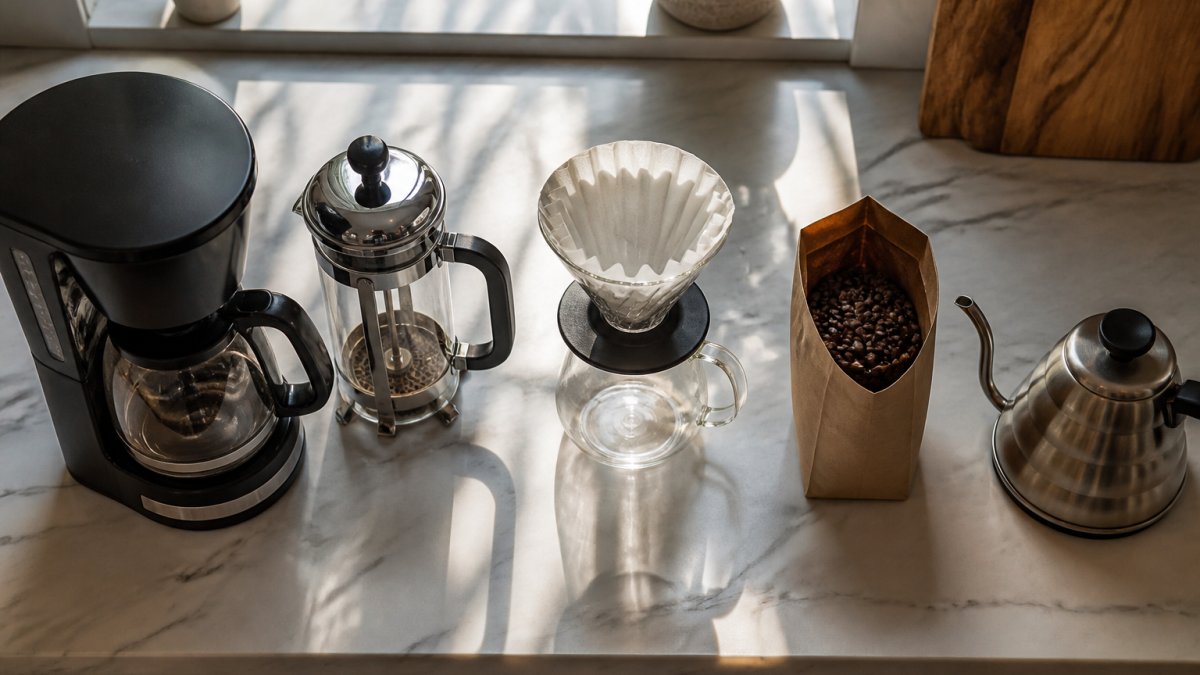
Seven methods cover nearly every beginner's needs: drip, espresso and capsules, cold brew, AeroPress, French press, pour-over, and the simple dripper. Each one trades effort for control in a different way. The Kitchn's side-by-side brewing test compared popular methods on effort and results, and the takeaway was clear: the winner depends on what you value.
Drip Coffee and Automatic Machines
Drip coffee is the lowest-effort path to a consistent cup. You add ground coffee and water, press start, and walk away. The trade-off is control: the machine decides water temperature and brew time for you. For an everyday cup, pair a drip machine with our Best Sellers Sample Pack: 6Bean, Cowboy, Breakfast, Peru, Mexico, Bali.

Espresso and Single-Serve Capsules
Espresso delivers concentrated shots with a thick body, but it demands a capable machine and a fine, consistent grind. Capsules skip the learning curve entirely. Our 12 Pack Single Serve Coffee Capsules seal each pod without oxygen so the coffee stays fresh.

Cold Brew and AeroPress
Cold brew steeps coffee grounds in cold water for hours, producing a smooth, low-acid concentrate; a 2025 review in Beverages on brewing methods and cup quality describes cold brew and cold drip as cold-water preparations. AeroPress is the opposite: fast, portable, and forgiving.
French Press Coffee for Beginners: The Forgiving First Brewer
French press coffee is the most forgiving manual method for beginners because it needs no paper filter and tolerates small grind errors. You steep coarse grounds in hot water for about four minutes, then press slowly. The mesh filter lets oils through, which gives a heavier body and richer mouthfeel than filtered methods. The catch: sediment reaches the cup, and cleanup takes a minute longer than rinsing a paper filter. Still, for a new brewer who wants a bold, smooth cup with minimal equipment, the French press is where we would start.
Pour-Over Coffee for Beginners: Clarity Without the Fuss
Pour-over coffee is a manual method where hot water is poured over ground coffee in a filter, producing a clean cup with sharp clarity and distinct subtle flavors. A single dripper and paper filters cost little, and the ritual takes about three minutes. The fuss is in the pour: uneven saturation causes weak or bitter spots. Pour in slow spirals, keep the water between 195-205°F, and let the bed drain evenly. Where the French press gives you body, pour-over gives you aroma and definition. Beginners who care about tasting a bean's origin should learn it.
Nailing the Coffee-to-Water Ratio Every Time
The coffee-to-water ratio is the single variable that most changes your cup, and a repeatable ratio beats a perfect one. Start with 1 gram of coffee per 16 grams of water. Since most beginners lack a scale, use this volume shortcut:
| Method | Coffee | Water | Brew Time |
|---|---|---|---|
| Drip | 2 tbsp | 6 oz | Machine cycle |
| French press | 2 tbsp | 8 oz | 4 minutes |
| Pour-over | 2 tbsp | 6 oz | 3 minutes |
| AeroPress | 1.5 tbsp | 6 oz | 1.5 minutes |
Write your ratio down. Repeatability, not perfection, is what makes a beginner's coffee improve week over week.
The Best Coffee Grinder for Beginners and Why Grind Size Matters
The best coffee grinder for beginners is a burr grinder, because it produces evenly sized particles instead of the dust-and-boulders mix a blade grinder creates. Grind size controls extraction: fine grounds release flavor fast, coarse grounds release it slowly. Match the grind to the method, from fine for espresso to coarse for French press, and grind just before brewing to protect aroma.
Equipment and Ongoing Cost Comparison
Startup cost and cost per cup diverge sharply across methods, and the cheapest brewer is rarely the cheapest habit. The table below uses realistic entry-level prices for a beginner buying new equipment, plus the recurring costs that actually determine what you spend over a year. Figures are typical U.S. retail ranges; sales and bundle deals move them, so treat them as planning numbers rather than quotes.
| Method | Entry-Level Equipment | Recurring Cost | Effort | Cleanup |
|---|---|---|---|---|
| Drip machine | $30-$120 | Paper filters ($5-$10 per 100); descaling solution | Minimal | Rinse carafe; descale monthly |
| Capsules | $60-$150 machine | Pods ($0.50-$1.00 each) | Minimal | Empty pod bin; descale quarterly |
| French press | $20-$40 | None (mesh filter is reusable) | Low | Rinse and disassemble; 1-2 minutes |
| Pour-over | $15-$40 dripper + $15-$30 kettle | Paper filters ($5-$10 per 100) | Moderate | Compost or trash filter; rinse dripper |
| AeroPress | $35-$50 | Paper micro-filters ($5-$8 per 350) | Low | Rinse plunger and cap; 30 seconds |
| Cold brew | $20-$40 jar or $30-$80 tower | Paper or cloth filter | Plan ahead (12-18 hours) | Rinse filter; refrigerate concentrate |
Cost per cup is where the math flips. A 12-ounce bag of whole-bean coffee at $12-$18 yields roughly 30-40 cups at a 1:16 ratio, or about $0.35-$0.60 per cup in beans. Add the method's recurring cost:
- Drip: about $0.05-$0.10 per cup in filters, plus electricity.
- Capsules: $0.50-$1.00 per pod, often 2-3x the bean cost of drip for the same cup size.
- French press, pour-over, AeroPress, cold brew: filters cost pennies per cup or nothing at all; the bean is the only recurring expense.
Over a year of one cup a day, a capsule habit can run $180-$365 in pods alone, while a French press or AeroPress setup costs $20-$50 once and then tracks the price of beans. That is the trade-off beginners should see before they buy: capsules win on convenience, manual methods win on long-run cost.
A durable mug matters more than beginners expect; our branded merchandise includes mugs that handle daily use without fuss. Maintenance is the hidden cost: descale drip machines and capsule machines monthly with a descaling solution, rinse French press mesh thoroughly so old oils do not turn rancid, and compost paper filters where you can. Reusable metal or cloth filters cut ongoing cost further but need rinsing after every brew.
Beginner Mistakes That Ruin a Good Cup
Most beginner guides list mistakes; few tell you how to diagnose the cup in front of you. Taste is the feedback loop, and four flavors point to four different fixes. Use this as a troubleshooting chart before you change equipment.
Weak or watery coffee. The water is running through too fast or there is too little coffee. Fix: tighten the grind one step finer, add 1-2 grams of coffee per 6 ounces of water, and check that your water is actually 195-205°F. On a drip machine, a weak pot often means the basket is overloaded or the grind is too coarse for the filter.
Bitter coffee. Over-extraction or water that is too hot. Fix: coarsen the grind one step, drop water temperature just off the boil (about 200°F), and shorten brew time by 15-30 seconds. In a French press, bitter usually means you steeped past four minutes or pressed too hard and drove sediment through the mesh.
Sour or sharp coffee. Under-extraction. Fix: grind finer, raise water temperature toward 205°F, and stir the grounds during the bloom so water reaches every particle. Sour pour-over is almost always an uneven pour that channeled through one side of the bed.
Muddy or silty coffee. Too many fine particles reaching the cup. Fix: coarsen the grind, rinse the French press mesh before pressing, and in pour-over, avoid pouring directly onto the filter wall. A blade grinder is the usual culprit here, because it produces dust alongside boulders.
Beyond flavor, four habits quietly ruin good coffee:
- Stale, pre-ground coffee. Buy whole beans and grind close to brew time; pre-ground coffee loses aroma within days of opening.
- Water that is too hot. Boiling water scalds grounds and turns the cup bitter; let it rest 30 seconds after the boil.
- Guessing at ratios. A repeatable ratio beats a perfect one; write down what you used so you can adjust one variable at a time.
- Skipping cleanup. Old oils in a French press or drip carafe turn rancid and taint every later cup.
Fix these and most "bad coffee" problems disappear without buying new gear.
Which Brewing Method Fits Your Morning?
Match the method to your routine, not to a ranking. If you want speed and consistency, choose drip or capsules. If you want a rich, forgiving manual brew, choose French press. If you want clarity and aroma, choose pour-over. If you want a cold, smooth concentrate ready in advance, choose cold brew. No single method is established as best for every beginner, which is exactly why the decision belongs to you.
Start With Fresh Beans From Skelton Mills Coffee
Great equipment cannot rescue stale beans, and that is the challenge worth solving first. Skelton Mills Coffee sources beans from trusted farms and roasts each batch to order, so maximum flavor and aroma reach your grinder rather than fading on a shelf. Browse our coffee to find a roast for your chosen method, or try the Single Origin Favorites Sample Pack to taste how origins differ before committing to a full bag. Get started with Skelton Mills Coffee and brew a cup that finally tastes like the beans deserve.

Frequently Asked Questions
What is the ideal coffee-to-water ratio for a beginner?
Start with 1 gram of coffee to 16 grams of water, which works out to roughly 2 tablespoons of ground coffee per 6 ounces of water. That ratio produces a balanced cup across most coffee brewing methods, from drip to pour-over. If the result tastes thin or sour, tighten it to 1:15; if it tastes bitter or muddy, loosen it toward 1:17. Weigh your coffee on a kitchen scale for the first few weeks so the ratio stays repeatable, then you can eyeball it once you know what a good cup looks like in your brewer.
Which coffee brewing method is easiest for a total beginner?
A drip coffee maker or single-serve capsule machine is the easiest entry point because the machine controls water temperature and brew time for you. French press coffee for beginners is the simplest manual option: add coarse grounds and hot water, wait four minutes, press, and pour. Pour-over takes a bit more attention to pouring technique but rewards you with a cleaner, brighter cup. Pick based on how much effort you want each morning, not on which method sounds most impressive.
Do I need a burr grinder to make good coffee at home?
A burr grinder gives you consistent particle size, which is the single biggest factor in even extraction. Blade grinders chop unevenly, so you get fine dust and coarse chunks in the same dose, and the cup tastes both bitter and weak. The best coffee grinder for beginners is a budget conical burr model, ideally one with adjustable settings so you can move between coarse for French press and medium for drip. If you buy pre-ground coffee, ask for the grind that matches your brewer and use it within two weeks.
What is the difference between French press and pour-over coffee?
French press steeps grounds fully in water and filters through a metal mesh, so oils and fine particles stay in the cup, giving a heavier body and richer mouthfeel. Pour-over passes water through a paper filter, which traps oils and sediment and produces a lighter, clearer cup with more pronounced acidity and aroma. Neither is better; they suit different tastes. If you like bold, smooth coffee, start with French press. If you want to taste subtle flavors in a single-origin bean, pour-over shows them off more clearly.
Is it better to grind coffee right before brewing?
Yes. Ground coffee loses aroma compounds within minutes of grinding because the increased surface area exposes the oils to oxygen. Grinding right before you brew preserves the flavor profile and aroma that fresh-roasted beans are known for. If your schedule makes daily grinding unrealistic, grind a batch for the week and store it in an airtight container away from light and heat, but expect a noticeable drop in brightness by day five. Whole beans stay fresh far longer, which is why a grinder pays for itself.
How fine should coffee be ground for different brewing methods?
Grind size should match how long the water contacts the coffee. Espresso needs a fine grind, close to powdered sugar, because the shot pulls in under 30 seconds. Drip and pour-over sit in the medium range, like table salt. French press and cold brew need coarse grounds, similar to sea salt, because they steep for four minutes to twelve hours. A finer grind than your method calls for over-extracts and tastes bitter; a coarser grind under-extracts and tastes sour or watery.
